ARC LEADERSHIP SPOTLIGHT
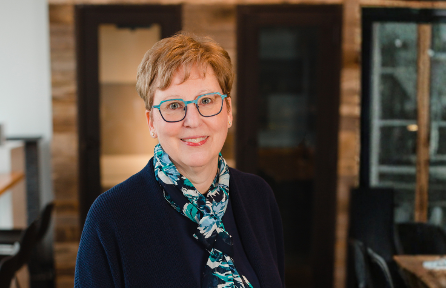

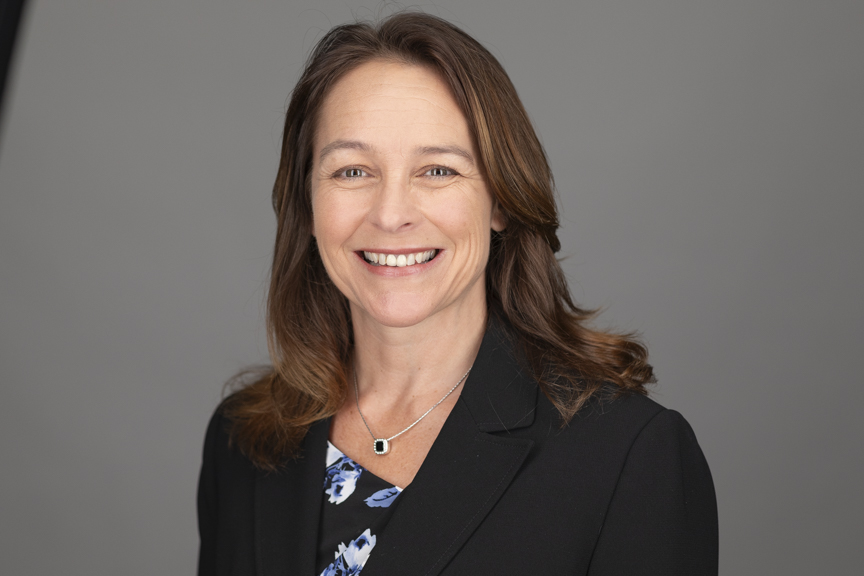
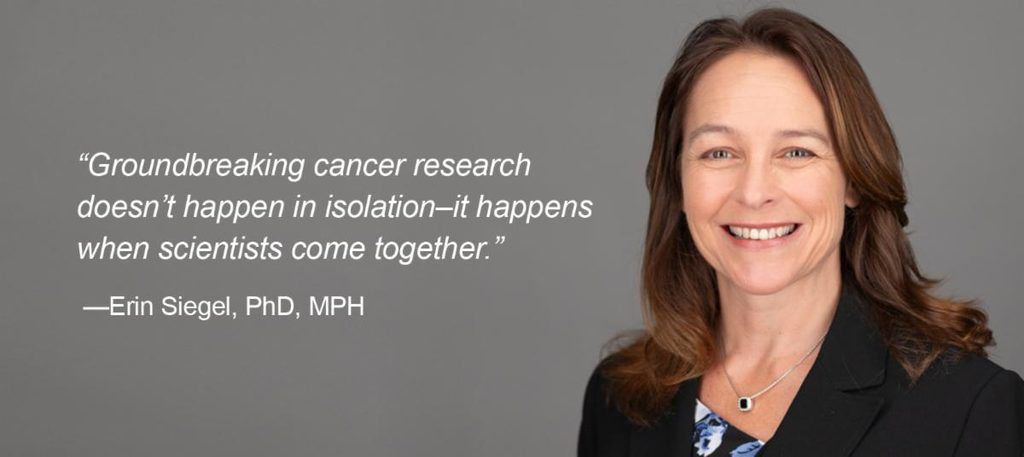
An interview with ARC Program Officer Dr. Erin Siegel, Former National Cancer Institute Associate Director of Epidemiology and Genomics Research | Photo courtesy of Dr. Erin Siegel
Dr. Siegel is the powerhouse behind ARC’s tremendous work on the Rare Cancer Data Initiative. She provides scientific leadership within ARC and with ARC partners to build out the mission, vision, and operational strategy for the organization. Her insights are a powerful reminder that when patients, researchers, and foundations unite, new science can deliver greater access to the life-saving treatments rare cancer patients deserve—one more reason to hope. Read Dr. Siegel’s bio.
In brief, as ARC Program Officer, Dr. Erin Siegel:
Meet Erin
“I am a cancer epidemiologist and have spent most of my career at the Moffitt Cancer Center in Tampa, Florida. During my 20 years at Moffitt, my research focused on improving survivorship for colorectal cancer patients. I was also the scientific director and ultimately Principal Investigator of Moffitt’s tissue biorepository, which led to my work in a large multi-center network across 18 national cancer centers. I also served as the Associate Director of Epidemiology and Genomics at the National Cancer Institute.
“ As a cancer epidemiologist, I bring decades of expertise in coordinating data sharing and biospecimen collection for thousands of samples to ARC and its Rare Cancer Data Initiative. I believe that my impact can be exponentially bigger when I bring teams together to build resources that drive research forward.”
How Did You Learn About the Jedi Rare Cancer Foundation?
“I was invited to the 2023 Rare Cancer Workshop, co-sponsored by the Jedi Foundation and Case Comprehensive Cancer Center (Case CCC) in Cleveland, Ohio. During this first-of-a-kind rare cancer brainstorm session, I was motivated by the passion of everyone in the rare cancer field. I also saw the potential for how I could participate. Since the network that I worked in had molecular data on thousands of cancer patients, I saw an opportunity to share data. I thought if we could take data that we had generated on all those patients, and bring the data together across groups, we could create a network of networks. I readily agreed to become a founding member of the Alliance for Rare Cancers leadership council and am honored to now serve as the Program Officer. ARC is doing so much important work to bring people together to create the masses of data needed to find new therapies. We’re the glue that brings the different organizations together.”
Why is this Rare Cancer Data Initiative Important Now?
“Each year, one in four cancer patients in the U.S. is diagnosed with a rare cancer, yet most face limited or nonexistent treatment options. This new data generation initiative seeks to address that gap by building a scalable platform for the foundational comprehensive datasets needed to power next-generation immunotherapies and AI-driven treatment discovery for rare cancer patients.
“In November 2025, ARC in collaboration with Case CCC and the Rare Cancer Research Foundation (RCRF), received a $1M grant from the Chan Zuckerberg Initiative’s Biohub to support the initiative’s two-year pilot program. This is an unprecedented collaboration, bringing leaders in the rare cancer space together to maximize the tissue samples that are available and generate data for patients with rare cancer. The goal of the initiative’s pilot program is to collect and generate rich clinical and molecular data on 158 tumors across eight rare brain and six rare sarcoma cancers and make tissue data freely available via RCRF’s pattern.org open-source repository. RCRF’s pattern.org program also enables patients to directly donate their tissue, fluids and/or medical information to high-impact research projects.
Rare Cancer Data Initiative Milestones Update
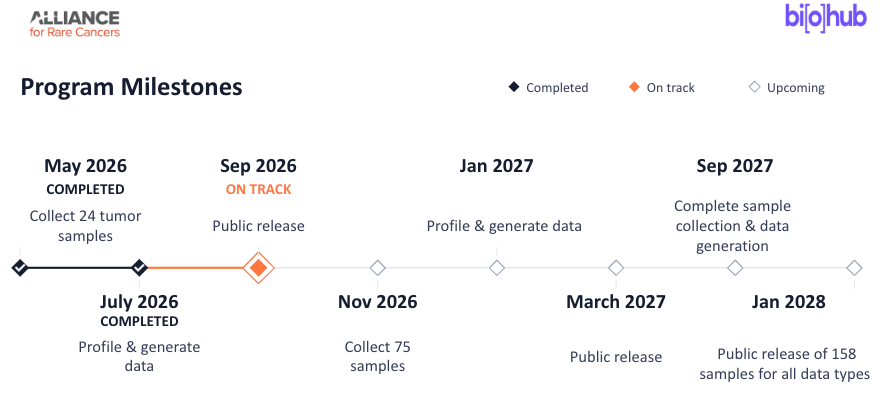
“We have met three of the program’s milestones: in May, we completed the collection of 24 tissue samples; in July, we completed profiling and generating data on these samples, and are now excited to share data from some of these rare cancer samples in October.
“Every tissue sample matters. We have built and are evolving the infrastructure to collect, organize, and share comprehensive molecular and clinical data from rare cancer patients and there is an urgent need for open-source research, cooperation, and coordination across institutions in the race for lifesaving treatments for rare cancer patients. Dr. Tyler Miller, as Principal Investigator and representative of CASE CCC, is responsible for the technical, scientific, and programmatic aspects of the program, and Dr. Marshall Thompson, Principal Investigator and representative from RCRF, is the technical expert leading RCRF’s Pattern Data Commons, which makes data widely available to help scientists share research data to test new drugs and therapies.”

Why is Rare Cancer Research Urgent?
“Advances in our understanding and treatment of rare cancers have not kept up with advances for more common cancers. One reason is that collaboration and sharing is essential when studying something so rare and this broad sharing is not the norm in research for many reasons such as financial benefit and intellectual property. ARC and our partners are working on getting researchers and major cancer centers to recognize the need to cooperate and coordinate across institutions, and the importance of open-source data on these rare cancers. Rare cancer researchers currently have a difficult time getting the samples they need to study the disease(s) they work with and many organizations do not collaborate or share their data and findings with one another, which negatively impacts progress. As a result, breakthroughs for many rare cancer patients are delayed, as many medical centers see too few rare cancer patients to begin with to observe patterns of the disease or connect patients to researchers. So, much of my efforts involve explaining the importance of why collaboration across rare cancer research is urgent for driving new lifesaving therapies for rare cancer patients.
Why is Support from the Jedi Community Critical?
“Jedi support helped lay the foundation needed to develop concepts for the current CZI Biohub grant. We would not have that funding if it was not for the Jedi community. One of our funding goals is to increase the number of patients per rare cancer type, as well as expand the number of cancers we study. ARC has multiple grants in the works but rare cancers have traditionally been underfunded, so bridging those gaps is of the utmost importance. The Jedi community’s ongoing donations help support the professional management of grants we receive and the formation of important partnerships. The batches of patient tissue samples will get bigger as we bring in more cancer centers and stakeholders. We are also focused on expanding a rare cancer patient network with multiple cancer centers across the U.S. to bring ultra-rare clinical data together and facilitate patient tissue donation. Bringing these biospecimens together for model development and testing will generate the data that can lead to lifesaving treatments and new therapies.”

Your generous donation has the power to save lives.
Together, we will END rare cancer.
Comment, Like, Share & Follow Us on Social Media.
Together, we can take action against rare cancer and help save lives.

The Jed Ian Taxel Foundation for Rare Cancer Research | P.O. Box 84, Dobbs Ferry, NY 10522
The Jed Ian Taxel Foundation for Rare Cancer Research, Inc. is a 501 (C)(3) Non-Profit Organization, accepting Tax Deductible donations from individuals, corporations, family-advised funds and foundations. Federal Tax ID 86-2610819
DISCLAIMER: THIS WEBSITE DOES NOT PROVIDE MEDICAL ADVICE The information, including but not limited to, text, graphics, images and other material contained on this website are for informational purposes only. No material on this site is intended to be a substitute for professional medical advice, diagnosis or treatment. Always seek the advice of your physician or other qualified health care provider with any questions you may have regarding a medical condition or treatment and before undertaking a new health care regimen, and never disregard professional medical advice or delay in seeking it because of something you have read on this website.